Published Saturday, November 17, 2007
 The Celsius temperature scale (also known as centigrade scale) is a scale on which the freezing point of water is 0 degrees Celsius and the boiling point of water is 100 degrees Celsius (at one atmosphere of pressure). Centigrade means "consisting of or divided into 100 degrees" whereby the interval between the freezing and boiling points of water are divided into 100 equal parts. This scale was introduced in 1742 by Celsius (1701-44), a Swedish astronomer and physicist. The Celsius temperature scale (also known as centigrade scale) is a scale on which the freezing point of water is 0 degrees Celsius and the boiling point of water is 100 degrees Celsius (at one atmosphere of pressure). Centigrade means "consisting of or divided into 100 degrees" whereby the interval between the freezing and boiling points of water are divided into 100 equal parts. This scale was introduced in 1742 by Celsius (1701-44), a Swedish astronomer and physicist.
Fahrenheit is a temperature scale that was named after the German physicist Daniel Gabriel Fahrenheit (1686-1736), who introduced it in 1724. The Fahrenheit scale is one in which the freezing point of water is 32°F and the boiling point of water 212°F.
The formulas and explanation below will help you to quickly make conversions between the Fahrenheit and Celsius temperature scales.
Fahrenheit and Celsius Temperature Scales Conversion
To convert a Celsius temperature into degrees Fahrenheit:
First multiply the Celsius temperature reading by nine-fifths then add this number to 32 to get the answer in °F.
In symbol form we have;
F = ((9/5)* °C)+32
Example:
Convert 100 °C into °F
Using the equation, F = ((9/5)* °C)+32
we have;
F = ((9/5)* 100 )+32
F = (180)+32
F = 212
This means that 100 °C (the boiling point of water) is equivalent to 212 °F (the boiling point of water) on the Fahrenheit scale.
To convert a Fahrenheit temperature into Celsius:
First subtract 32 from the Fahrenheit temperature then multiply this number by five-ninths to the answer in °C.
In symbol form we have;
°C = (5/9)*(F-32)
Example:
Convert 32 °F into °C
Using the equation, °C = (5/9)*(F-32)
we have;
°C = (5/9)*(32 -32)
°C = (5/9)*(0)
°C = 0
This means that 32 °F (freezing point of water) is equivalent to 0 °C (freezing point of water) on the Celsius scale.
Related Articles:
General Conversion Formula: Unit Conversion Reference Table
SI Prefixes and Symbols: Metric Prefixes
Distance Conversion: Miles and Kilometers
What are Roman Numerals?
How to read and write Roman NumeralsLabels: Kitchen Measurement, Mathematics, Measuring Units
Published Saturday, October 13, 2007
 Below is a Unit Converter table showing the General Conversion Formula to convert from one unit to another. So if you need to convert from square miles to square kilometers, miles to kilometers, acres to hectares, pounds to kilograms, inches to centimeters, feet to meters or vice versa and so on, then you will find this conversion table for different units very useful. Below is a Unit Converter table showing the General Conversion Formula to convert from one unit to another. So if you need to convert from square miles to square kilometers, miles to kilometers, acres to hectares, pounds to kilograms, inches to centimeters, feet to meters or vice versa and so on, then you will find this conversion table for different units very useful.
Conversion of Units
| From | To | Multiply by | inches
| millimeters
| 25.4
| millimeters
| inches
| 0.0394 | inches
| centimeters
| 2.54 | centimeters
| inches
| 0.3937 | feet
| meters
| 0.3048 | meters
| feet | 3.281 | yards
| meters
| 0.9144 | meters
| yards
| 1.094 | miles
| kilometers
| 1.609 | kilometers
| miles
| 0.6214 | sq inches
| sq centimeters | 6.452 | sq centimeters
| sq inches
| 0.155 | sq meters
| sq feet
| 10.76 | sq feet
| sq meters
| 0.0929 | sq yards
| sq meters
| 0.8361 | sq meters
| sq yards
| 1.196 | sq miles
| sq kilometers
| 2.589 | sq kilometers
| sq miles
| 0.3861 | acres
| hectares
| 0.4047 | hectares
| acres
| 2.471 | cu inches
| cu centimeters
| 16.39 | cu centimeters
| cu inches
| 0.06102 | cu feet
| cu meters
| 0.02832 | cu meters
| cu feet
| 35.315 | cu yards
| cu meters
| 0.7646 | cu meters
| cu yards
| 1.308 | cu inches
| liters
| 0.01639 | liters
| cu inches
| 61.03 | pints
| liters
| 0.5682 | liters
| pints
| 1.76 | US pints
| liters
| 0.47311 | liters
| US pints
| 2.114 | US gallon
| liters
| 3.785 | gallons
| liters
| 4.546 | liters
| US gallons
| 0.2642 | liters
| gallons
| 0.22 | grains
| grams
| 0.0648 | grams
| grains
| 15.43 | ounces
| grams
| 28.35 | grams
| ounces
| 0.03527 | pounds
| grams
| 453.6 | grams
| pounds
| 0.002205 | pounds
| kilograms
| 0.4536 | kilograms
| pounds
| 2.205 | tons
| kilograms
| 1016.05 | kilograms
| tons
| 0.0009842 |
Related Articles:
SI Prefixes and Symbols: Metric Prefixes
Distance Conversion: Miles and Kilometers
What are Roman Numerals?
How to read and write Roman NumeralsLabels: Mathematics, Measuring Units
Published Saturday, June 02, 2007
 SI prefixes (metric prefixes) are short names and letter symbols that precedes a unit of measure or its symbol. SI prefixes are applied and attached to unit of the International System of Units (SI) which are used to form new subdivisions and multiples (unit symbol) of that unit - prefix symbol attached to the unit symbol. These prefix symbols strictly represent powers of 10 which can be raised to a positive or negative power, as well as, it can also combined with other unit symbols (unit of measure) to form compound unit symbols. They are represented in the general form 10n where n is ranged from anywhere between 24 to -24. As such, prefixes are multiples when n>0 and submultiples when n<0,> SI prefixes (metric prefixes) are short names and letter symbols that precedes a unit of measure or its symbol. SI prefixes are applied and attached to unit of the International System of Units (SI) which are used to form new subdivisions and multiples (unit symbol) of that unit - prefix symbol attached to the unit symbol. These prefix symbols strictly represent powers of 10 which can be raised to a positive or negative power, as well as, it can also combined with other unit symbols (unit of measure) to form compound unit symbols. They are represented in the general form 10n where n is ranged from anywhere between 24 to -24. As such, prefixes are multiples when n>0 and submultiples when n<0,>
| Prefix | Symbol | Factor | Ordinary Notation | Name |
|---|
| yotta | Y | 1024 | 1 000 000 000 000 000 000 000 000 | septillion | | zetta | Z | 1021 | 1 000 000 000 000 000 000 000 | sextillion | | exa | E | 1018 | 1 000 000 000 000 000 000 | quintillion | | peta | P | 1015 | 1 000 000 000 000 000 | quadrillion | | tera | T | 1012 | 1 000 000 000 000 | trillion | | giga | G | 109 | 1 000 000 000 | billion | | mega | M | 106 | 1 000 000 | million | | kilo | k | 103 | 1 000 | thousand |
| | hecto | h | 102 | 100 | hundred | | deka | da | 101 | 10 | ten |
|
|
| 100 | 1 | one |
| | deci | d | 10-1 | 0.1 | tenth | | centi | c | 10-2 | 0.01 | hundredth |
| | milli | m | 10-3 | 0.001 | thousandth | | micro | μ | 10-6 | 0.000 001 | millionth | | nano | n | 10-9 | 0.000 000 001 | billionth | | pico | p | 10-12 | 0.000 000 000 001 | trillionth | | femto | f | 10-15 | 0.000 000 000 000 001 | quadrillionth | | atto | a | 10-18 | 0.000 000 000 000 000 001 | quintillionth | | zepto | z | 10-21 | 0.000 000 000 000 000 000 001 | sextillionth | | yocto | y | 10-24 | 0.000 000 000 000 000 000 000 001 | septillionth |
|
Related Articles:Distance Conversion: Miles and KilometersWhat are Roman Numerals?Labels: Mathematics, Measuring Units
Published Saturday, September 16, 2006
 Have you ever had to convert kilometers to miles or miles to kilometers? If your answer is yes then, this article is for you. Kilometer or kilometre (symbol: km) is the standard measurement of distance which is the current International System of Unit (SI) for distance. Miles was the traditional unit Have you ever had to convert kilometers to miles or miles to kilometers? If your answer is yes then, this article is for you. Kilometer or kilometre (symbol: km) is the standard measurement of distance which is the current International System of Unit (SI) for distance. Miles was the traditional unit used to measure distance however with the International System of Unit (SI), distance is now measured in kilometers. This means you will find most countries worldwide using kilometer instead of miles to measure distance. However, not all countries are completely using the kilometre as a standard measurement for distance. One such country is the United States. You will still find some road signs given in miles to indicate distances to cities, towns, airports etc. while on the other hand, you will see some also in kilometers at some areas. used to measure distance however with the International System of Unit (SI), distance is now measured in kilometers. This means you will find most countries worldwide using kilometer instead of miles to measure distance. However, not all countries are completely using the kilometre as a standard measurement for distance. One such country is the United States. You will still find some road signs given in miles to indicate distances to cities, towns, airports etc. while on the other hand, you will see some also in kilometers at some areas.
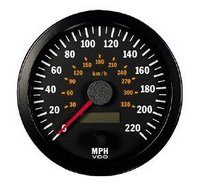 Also, you can always know how fast or slow your car is going by the use of a speedometer. A speedometer is a meter fixed to a vehicle dashboard and is used for indicating the vehicle's rate of travel in miles or kilometers per hour. It continuously measures a vehicle's Also, you can always know how fast or slow your car is going by the use of a speedometer. A speedometer is a meter fixed to a vehicle dashboard and is used for indicating the vehicle's rate of travel in miles or kilometers per hour. It continuously measures a vehicle's speed and can displays it either numerically or by means of a needle on a dial. Thus, in other words, this meaures how fast your car is moving per hour in both miles and kilometers. Miles per hour can be written as (m/h) or “mph” and kilometre per hour can be written as (km/h) or “kph”. speed and can displays it either numerically or by means of a needle on a dial. Thus, in other words, this meaures how fast your car is moving per hour in both miles and kilometers. Miles per hour can be written as (m/h) or “mph” and kilometre per hour can be written as (km/h) or “kph”.
 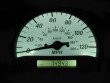  Distance Conversion CalculationsConversion from Kilometers to MilesTo convert from Kilometers to Miles, multiply the kilometers by 0.62 Conversion from Miles to KilometersTo convert from Miles to Kilometers, multiply the miles by 1.61 or more precisely by 1.609 344 Conversion from miles per hour (m/h) to kilometers per hour (km/h)To convert from miles per hour (m/h) to kilometers per hour (km/h) multiply the miles per hour by 1.6 or more precisely, by 1.609 344
Conversion of Miles to Kilometers| Miles | Kilometers |
|---|
| 1 | 1.6 | | 2 | 3.2 | | 3 | 4.8 | | 4 | 6.4 | | 5 | 8.0 | | 6 | 9.6 | | 7 | 11.2 | | 8 | 12.8 | | 9 | 14.4 | | 10 | 16.1 | | 20 | 32.1 | | 30 | 48.2 | | 40 | 64.3 | | 50 | 80.4 | | 60 | 96.5 | | 70 | 112.6 | | 80 | 128.7 | | 90 | 144.8 | | 100 | 160.9 | | 1,000 | 1609.3 |
Conversion of Kilometers to Miles| Kilometers | Miles |
|---|
| 1 | 0.6 | | 2 | 1.2 | | 3 | 1.8 | | 4 | 2.4 | | 5 | 3.1 | | 6 | 3.7 | | 7 | 4.3 | | 8 | 4.9 | | 9 | 5.5 | | 10 | 6.2 | | 20 | 12.4 | | 30 | 18.6 | | 40 | 24.8 | | 50 | 31.0 | | 60 | 37.2 | | 70 | 43.4 | | 80 | 49.7 | | 90 | 55.9 | | 100 | 62.1 | | 1,000 | 621.0 |
Labels: Mathematics, Measuring Units
Published Monday, July 10, 2006
 Roman Numerals are numerical symbols formed with the Roman letters I, V, X, L, C, D, and M, representing respectively the numbers 1, 5, 10, 50, 100, 500, and 1000, used by the ancient Romans. If interested, you can visit here to learn: How to read and write Roman Numerals. Roman Numerals are numerical symbols formed with the Roman letters I, V, X, L, C, D, and M, representing respectively the numbers 1, 5, 10, 50, 100, 500, and 1000, used by the ancient Romans. If interested, you can visit here to learn: How to read and write Roman Numerals.
A Synopsis on the History of Roman NumeralsRoman numerals were the standard numbering system and method of Arithmetic in Ancient Rome and Europe. Rome being the world leader at the time was dominant and very active in trade and commerce and needed a way to indicate numbers to carry out their daily business (finances) and to calculate their taxes. Also, being a modernized society in their era there was a demand and need to improve their architectual capabilities in building roads, bridges, fortresses, temples, stadiums, ships etc, as they expanded and their society became more sophisticated. It was then that Roman scholars invented numerical characters known as Roman Numerals as a standard numbering system. This system was in use up to about 900 AD, when the Hindu's originated the Arabic Numbering System ( Arabic numerals). Arabic numerals (also called Hindu numerals or Indian numerals or Western numerals ) are the most common set of symbols used to represent numbers and is also the one we use today. Arabic numerals is made up of the characters 0, 1, 2, 3, 4, 5, 6, 7, 8, 9 and in general European use since the 12th century. Unlike the Arabic numerals, Roman numerals didn't have a symbol for zero (0) and as a result, because the concept of zero did not exist, the numeral placement was sometimes based on subtraction rather than addition. The largest number that could be represented by the roman numerals system using their rules was 4,999. Traditional Use of Roman NumeralsTraditionally roman numerals were used to indicate the order of family offspring of the same name ( For example, II was used instead of Jr., III for the third, and IV for the fourth and so on) and also if the same surname were used by church leaders (Popes) and kings (whether or  not by off spring) this numbering system was used to indicate that order . In England, kings used this system of naming their kings that carried the same surname. The Romans in their time conquered many different countries and England was one of such countries. After conquering England, Romans settled there, where the English and other people would adapt the number system used by Romans. This is why for example kings of England like King Henry the 1st written as King I (pronounced: as King Henry the first) or king Henry the 8th written as Henry VIII (pronounced: King Henry the eight) used these roman numerals in their name. This is saying, using the latter as an example, that King Henry VIII was the 8th person to be King of England with the name "Henry". The same can be explained for Queen Elizabeth the 1st ( Elizabeth I) and Queen Elizabeth the 2nd (Elizabeth II), pronounced: Queen Elizabeth the Second, the present queen of England. If there should be another queen Elizabeth, she would be named Queen Elizabeth the third written as Queen Elizabeth III and would pronounced Queen Elizabeth the third. 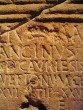 Roman Numerals were also used for as dating on cornerstones of buildings showing origin of a building, statutes, headstones, ships (e.g. Queen Elizabeth II), books publication such as in chapter titles, volume of book series, appendices and so on. The Use of Roman Numerals Today   Today the Roman Numerals are used as: i.) Numbers in publishing and media industries for copyright dates, ii) In books such as; pagination of preliminary pages (in lower case), appendices, chapter headings and title pages to show dates of publication. iii) Numerical labels in lower case in the listing of written content (e.g. i, ii, iii, iv etc.), iv) A part number to Arabic numbers (0, 1, 2, 3, 4, 5, 6, 7, 8, 9) in sub-list {1. (i), 1. (ii), 1. (iii) …2. (i), 2 (ii)… and alphabet sub-listing {A (i), A (ii), B (i), B (ii)…..etc.}. v) Clocks
vi) Watches,
vii) to indicate the anniversary of Super Bowl games in the US, viii) headstones, viiii) cornerstones of some building signifying date of construction etc. x) family offspring of the same surname name usually after the third consecutive use of the surname i.e. after using the term Sr. and Jr. xi) the naming of church leaders such as the Pope of the catholic church that may use the same name of previous Popes. xii) the numbering of movie sequels Related Article:How to read and write Roman NumeralsLabels: Mathematics
Published Saturday, February 18, 2006
 Roman numerals are a system of numerical notations used by the Romans. It was the standard number system used by the Romans and other ancient Europeans. Rome being the world leader at the time were leaders in trade and commerce and as such they created a system where they could calculate their everyday finances. Also, being a modernize society in their era there was a Roman numerals are a system of numerical notations used by the Romans. It was the standard number system used by the Romans and other ancient Europeans. Rome being the world leader at the time were leaders in trade and commerce and as such they created a system where they could calculate their everyday finances. Also, being a modernize society in their era there was a demand and need to improve their architect capabilities in building roads, bridges etc; as they expanded and their society became more sophisticated. Thus, a numerical system was developed which resulted in the development of their mathematical skills to build a civil society that had buildings such as the Colosseum, Constantine's Arch, Pantheon and Roman Baths. demand and need to improve their architect capabilities in building roads, bridges etc; as they expanded and their society became more sophisticated. Thus, a numerical system was developed which resulted in the development of their mathematical skills to build a civil society that had buildings such as the Colosseum, Constantine's Arch, Pantheon and Roman Baths.
Roman numerals are used today as a formality or just to add a classic style and elegance to ones work depending on ones taste or fashion.
After reading this article you should be able to:
- Recognize Roman numerals when you see them.
- Identify each symbol and what it stands for in Arabic numbers:
- Be able to transfer Roman numerals into Arabic numbers.
- Be able to write the correct Roman numerals for Arabic numbers.
- Show appreciation for the use of Romans Numerals.
Introduction:
Arabic numerals (also called Hindu numerals or Indian numerals or Western numerals ) are the most common set of symbols used to represent numbers and is also the one we use today. Arabic numerals is made up of the characters 0, 1, 2, 3, 4, 5, 6, 7, 8, 9 from which all the other sets of numbers are derived from to form our present number system.
Roman numerals unlike Arabic numerals which we use today didn't have a symbol for zero. Thus, a roman numeral can sometimes be read based on subtraction within its numbers rather than addition. This will be demonstrated further below. The Romans Numerals however had two flaws 1) it had no zero (0) in its numerical system 2) there were no single method for one to count above several thousand units. The limit was 4,999. To compensate for this, lines were often placed over numerals to indicate multiples of their value. This was however taken care of several years after, with the introduction and adoption of Arabic numerals.
Roman numerals spread in many countries during that era and thus there were different ways of writing the numbers during the centuries. For example, four (4) was written as IIII which was changed to IV. This became the universal numerical symbol of modern times. This used the subtraction notation method which will be demonstrated below. These rules here are however the standard used today.
Reading and writing Roman numerals
Step 1: Learn the meanings of the letters used in ancient Rome to represent numbers
The Roman letters I, V, X, L, C, D, and M, representing respectively the numbers 1, 5, 10, 50, 100, 500, and 1000, used by the ancient Romans. In other words; I = 1; V = 5; X = 10; L = 50; C = 100; D = 500; M = 1000.
The numbers one through ten (1-10) are written:
I = 1, II = 2, III = 3, IV = 4, V = 5, VI = 6, VII = 7, VIII = 8, IX = 9, and X = 10.
Step 2 : Symbol Duplication
A Roman letter repeated once, twice or thrice repeats its value that many times.
Examples:
(XX = 20, CCC= 300, MMMM = 4000 etc.)
The Roman symbols V, L and D are not duplicated. This is due to the fact that their combined values can be expressed by other numerical symbols. For example, VV = 10 can also be written as X = 10. Thus, VV = 10 = X and therefore these three Romans number/symbols should not be doubled. Only powers of ten (X, I, C, M) can be repeated. No Roman Numeral must be repeated more than three times in a row. A common ancient Romans exception was IIII = 4 This is because IV is the first two letters of IVPITER, the main god of the Romans and thus it was not appropriate to use. However, this is now usually expressed by subordinate subtraction - IV. Today you may notice that some clocks still may use IIII instead of IV.
Step 3 : Simple Addition Rule
If a smaller Roman letter comes AFTER a larger letter, then add the value of the two characters together. In other words, if you put a small number (Roman letter) to the right of a large number (Roman letter) of greater value , then you add them.
Examples:
XV means 10+5 =15 thus, XV=15
LXXV means 50+10+10+5 = 75 thus, LXXV= 75
MCC means 1000+100+100 = 1200 thus, MCC = 1200
CLXVI means 100+50+10+5+1= 166 thus, CLXVI= 166
Step 4 : Subordinate Subtraction
If a smaller number (roman letter) comes BEFORE a larger number (Roman letter), then subtract the value of the smaller from the value of the larger number/letter. That is, if a small number is placed to the left of a large number, then you subtract the small one from the big one. The result is then added to the rest of the letters.
Here are some more rules for subtraction.
(a) only subtract powers of ten i.e. I, X, and C. The subtraction of V or L are NOT allowed;
(b) only subtract one number from another;
(c) do not subtract a number from one that is more than 10 times greater. In other words, you can subtract 1 from 10 [IX] but not from 20 because there is no such number as IXX.
(d) If another letter follows the larger one, it must be smaller than the number preceding the larger one.
Examples:
IX means 10 - 1 = 9 thus, IX =9
XL means 50 - 10 = 40 thus, XL = 40
CM means 1000-100= 900 thus, CM = 900
XLIX means (50 - 10) + (10 - 1) = 40+ 9 = 49 thus, XLIX= 49
XCIX means (100 - 10) + (10 - 1) = 90 + 9 = 99 thus, XCIX = 99
XLIII means (50 - 10) + 1 + 1 + 1 = 40+3 = 43 thus, XLIII = 43
In order to prevent duplication mistakes in their calculation of using their numeric system, it was necessary that certain numbers (compound numerals) must be written using subordinate subtraction. This preceding rule was put in place by their accountant (Tabularius - 'the worker of tables').
It is also important to note that subordinate subtraction was hardly ever done with duplicated Roman letters. For example, the Roman letters (numbers) IIX and CCD are both syntactically correct, but would more properly be represented by VIII and CCC respectively.
Step 5 : Higher Roman Numbers
For very large numbers (five thousand and above), a line (-) drawn over a numeral (letter) indicates that its value was to be multiplied by 1000.
Examples:
V with a bar over it would be 5000 (five thousand)
X with a bar over it would be 10,000 (ten thousand)
L with a bar over it would be 50,000 (fifty thousand)
C with a bar over it would be 100,000 (one hundred thousand)
D with a bar over it would be 500,000 (five hundred thousand)
M with a bar over it would be1,000,000 (one million)
Thus, let say XV = 15,
then X (with a line on top) V (with a line on top) = 15,000
Note:
Due to the fact that barred letters are hard to write in HTML format, this example is shown with non-barred letters with the written explanation.
Also , notice that the Roman number "I" was not barred since I-bar equals "M." that is, I * 1000 = M
If lines were drawn on the top (-) and both sides (|) of a numeral, its value was multiplied by a hundred thousand. ( * 100,000)
Examples:
|V| = 500,000 (five hundred thousand) and
|X| = 1,000,000 ( one million or ten hundred-thousands)
Tip: Converting from Arabic numerals to Roman numerals
When converting to Roman numerals, convert each digit separately. For example, for 752 convert 700, 50, and 2 to give CCCM, L. This will indicate wherever a subordinate symbol follows one of higher value. After this, the results combined to give the final figure.
Note: Roman Numerals are written in capital letters. This is because they did not have lower-case letters. So, remember to write it in capital letters.
To master this topic read this article twice making sure you understand it then get some practice by visiting the sites below. After this you should attain this article/lesson objectives and thus, you should be able to read and write Roman Numerals. Have fun!!
Related Article:
What are Roman Numerals?
Roman Numeral Converter | Roman Numeral Converter
Roman Numeral Converter and Self Test | Roman numerals matching gameLabels: Mathematics
|
|
Message Board
FeedBack Appreciated
Please spare some time to give your feedback about this site. Thanks in advance.
|
|
|
|
Message from the Author
 R. Edmondson
United States
R. Edmondson
United States
Did You Know site is used as a learning tool to provide a stimulating learning environment for general knowledge development; to promote increased diversity on the online learning community and to incorporate the site’s informative quality content with the best of online communication platform (blog) in making knowledge accessible and free to all.
Thanks for the support.
|
|
|
|
|


 The Celsius temperature scale (also known as centigrade scale) is a scale on which the freezing point of water is 0 degrees Celsius and the boiling point of water is 100 degrees Celsius (at one atmosphere of pressure). Centigrade means "consisting of or divided into 100 degrees" whereby the interval between the freezing and boiling points of water are divided into 100 equal parts. This scale was introduced in 1742 by Celsius (1701-44), a Swedish astronomer and physicist.